Webhooks
Webhooks
Console page: Developers › Webhooks, in an organization's console and in an environment console
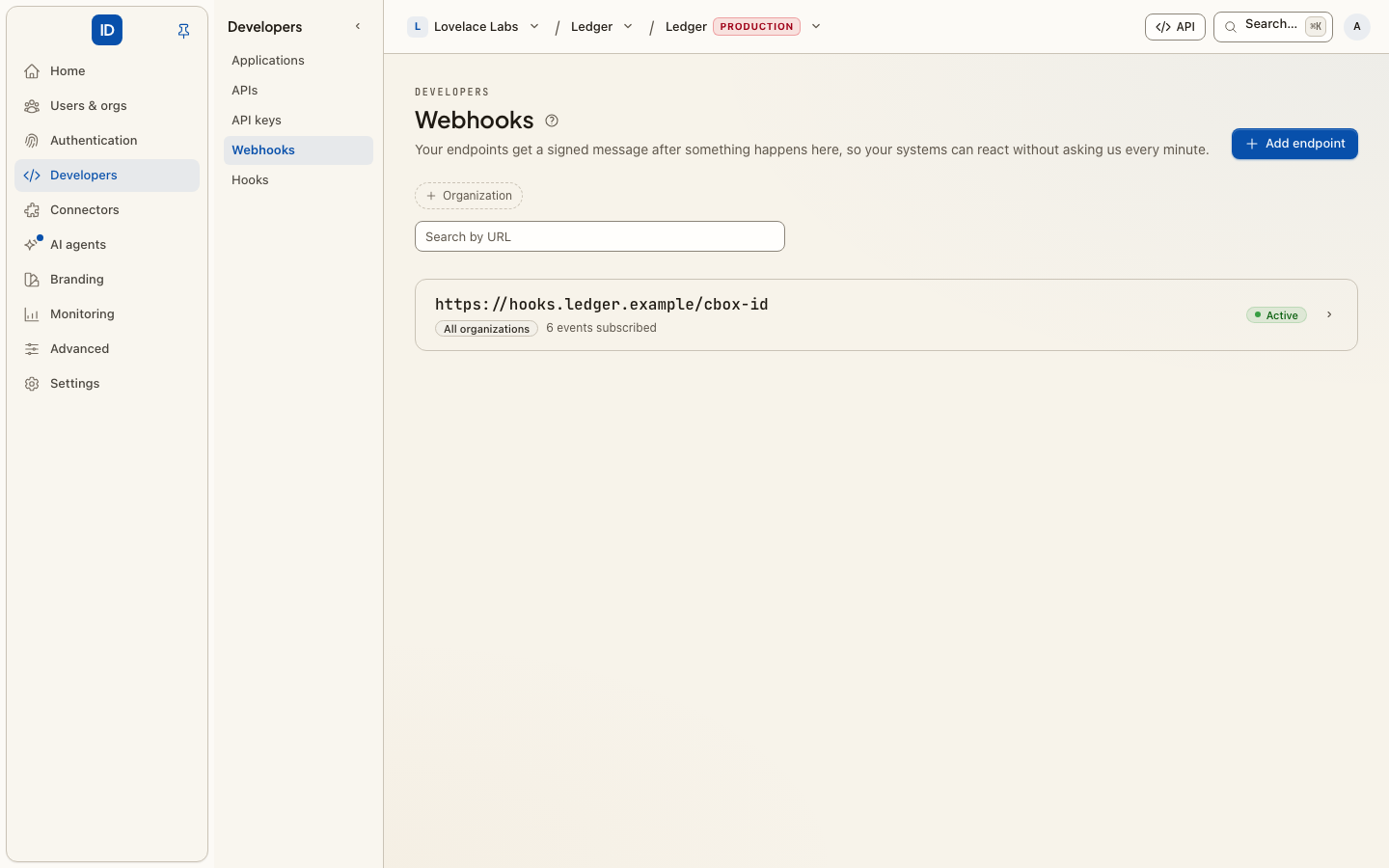
A webhook endpoint is a URL of yours that Cbox ID posts to after something happens: a member was added, a user signed in, a directory deactivated somebody. Your systems find out as it happens instead of polling, and — importantly — a webhook is a notification, not a vote. Your endpoint is told; it cannot hold anything up or refuse. If you need a say in the outcome, you want a hook instead.
Events you can subscribe to
The picker lists every event Cbox ID sends. The list comes from the catalogue in
cboxdk/laravel-id (webhook events reference).
Common ones:
| Event | Fires when |
|---|---|
user.created |
A person is created in this organization |
user.login |
A person signs in |
identity.linked |
An external identity is linked to a person |
membership.created |
Someone joins the organization |
membership.updated |
A member's role changes, including an ownership transfer |
membership.deleted |
Someone is removed from it, or leaves |
invitation.created / invitation.accepted / invitation.revoked |
An invitation's lifecycle |
organization.deleted |
The organization is closed |
directory.user.provisioned |
A directory sync created or updated a person |
directory.user.deactivated |
A directory sync deactivated a person |
Older names. organization.member_added, organization.member_removed and the other
organization.member_* and organization.invitation_* events are still sent to endpoints
that subscribe to them. They are no longer offered for new endpoints. An endpoint
subscribed to * receives both names for the same change, so count on one family only.
Set one up
- Add endpoint, give it your HTTPS URL, pick a signature scheme, and tick the events it should receive.
- Copy the signing secret. It is shown once.
- Verify every delivery against that secret before acting on it (below).
- Make something happen that the endpoint subscribes to, such as inviting a test member, and confirm the delivery arrives and verifies before you rely on it. There is no "send test event" button.
An endpoint in an organization's console carries that organization's events only. One created in an environment console can instead be environment-wide, carrying every organization's events, which is why the API makes you say which you mean.
From your backend or an agent, the same lifecycle is a set of actions, on the management API, MCP and the CLI alike:
| Action | REST | Scope | Danger |
|---|---|---|---|
webhooks.list, webhooks.get |
GET /api/v1/webhooks, GET /api/v1/webhooks/{id} |
webhooks:read |
read |
webhooks.create |
POST /api/v1/webhooks |
webhooks:write |
critical |
webhooks.update |
PATCH /api/v1/webhooks/{id} |
webhooks:write |
write |
webhooks.pause, webhooks.resume |
POST /api/v1/webhooks/{id}/pause, …/resume |
webhooks:write |
write |
webhooks.secret.rotate |
POST /api/v1/webhooks/{id}/rotate |
webhooks:write |
critical |
webhooks.signature_scheme.change |
POST /api/v1/webhooks/{id}/signature-scheme |
webhooks:write |
destructive |
webhooks.delete |
DELETE /api/v1/webhooks/{id} |
webhooks:write |
destructive |
webhooks.create takes url, event_types, an optional signature_scheme (cbox, the
default, or standard_webhooks, see signature schemes) and either
organization_id or "environment_wide": true, never neither. Its answer carries the signing secret once;
webhooks.secret.rotate issues a new one the same way. Creating an endpoint and rotating
its secret are critical, so a key with an approval policy may have to wait for a person
(step-up approvals). Every change, from the console or the API, is
on the audit log as webhook.*, naming who made it. See
the management API.
Pause an endpoint to stop deliveries while you work on the receiver without losing its configuration; Resume picks up again.
Can't accept inbound requests? Poll GET /api/v1/events?after=<last id> (events:read)
for the same events instead.
Signature schemes
Every delivery is signed with HMAC-SHA256 and the endpoint's secret. Each endpoint picks
how, when you create it (Signature scheme on the form, signature_scheme on the API):
Cbox (cbox, the default) |
Standard Webhooks (standard_webhooks) |
|
|---|---|---|
| Choose it when | your receiver already verifies X-Cbox-Signature, or uses a Cbox ID SDK |
your receiver uses a Standard Webhooks library, or a platform that verifies Standard Webhooks itself |
| Headers | X-Cbox-Timestamp, X-Cbox-Signature: t=<ts>,v1=<hex> |
webhook-id, webhook-timestamp, webhook-signature: v1,<base64> |
| Signed string | {timestamp}.{raw body} |
{webhook-id}.{timestamp}.{raw body} |
| Secret | 64 hex characters | whsec_ followed by base64 |
| HMAC key | the secret string, as written | the base64-decoded bytes after whsec_ |
| Signature encoding | lowercase hex | base64 |
A delivery carries only its own scheme's headers. The body is the same JSON envelope
either way: type, sequence, data and delivery_id. Under Standard Webhooks,
webhook-id is the delivery id. It stays the same on every retry, so dedupe on it.
For a new receiver with nothing built yet, Standard Webhooks is the easier choice: there is a ready-made library in most languages, and the message id arrives signed in a header.
Changing an endpoint's scheme
On the endpoint's page, Signature scheme › Change scheme, or
POST /api/v1/webhooks/{id}/signature-scheme with {"signature_scheme": "standard_webhooks"}.
No new secret is issued, and none is shown. The secret you already hold works under either scheme:
- Cbox → Standard Webhooks: your hex secret becomes
"whsec_" + base64(hexSecret). Base64-encode the 64-character hex string itself, not the bytes it spells. In PHP that is'whsec_'.base64_encode($hexSecret). - Standard Webhooks → Cbox: the whole
whsec_…string, prefix included, is the Cbox HMAC key as written.
Update your receiver first. The change applies from the next attempt, retries included. A receiver still verifying the old headers rejects every delivery until it is updated. Rejected deliveries are retried, but one that runs out of retries is lost. That is why the console asks you to type the endpoint's URL to confirm, and why the action is destructive even though you can switch back.
Rotating the secret mints it in the endpoint's current scheme: 64 hex characters under
Cbox, a whsec_ secret under Standard Webhooks.
Verifying a delivery
Whichever scheme you use:
- Read the raw body, before any JSON parsing or framework normalisation. A re-encoded body never verifies.
- Recompute the HMAC and compare with a constant-time comparison.
- Reject a timestamp outside a tolerance window (five minutes is usual), in both directions. This stops a captured delivery being replayed at you later.
- Answer
4xxto anything that fails. The delivery is retried.
Standard Webhooks
Any Standard Webhooks library verifies these deliveries with the whsec_ secret exactly
as it was shown.
Node
import { Webhook } from "standardwebhooks";

const wh = new Webhook(process.env.CBOX_ID_WEBHOOK_SECRET); // "whsec_…"

// rawBody: the request body as a string or Buffer, untouched.
// headers: an object with webhook-id, webhook-timestamp and webhook-signature.
const event = wh.verify(rawBody, headers); // throws if it does not verify
PHP (in a Laravel app with cboxdk/laravel-id installed, the framework ships the verifier)
use Cbox\Id\Webhooks\Exceptions\InvalidWebhookSignature;
use Cbox\Id\Webhooks\Support\StandardWebhookSignature;

try {
    StandardWebhookSignature::verify(
        $request->getContent(),          // the raw body
        $request->headers->all(),
        config('services.cbox_id.webhook_secret'), // "whsec_…"
    );
} catch (InvalidWebhookSignature $e) {
    return response('', 400);            // $e->reason says why
}
Without the framework, use the Standard Webhooks library for PHP, or compute it yourself:
base64-decode the secret after whsec_, HMAC-SHA256 "{webhook-id}.{webhook-timestamp}.{raw body}"
with those bytes, base64-encode the result, and compare it in constant time with each
space-separated v1,<signature> entry of webhook-signature.
Python
from standardwebhooks.webhooks import Webhook

wh = Webhook(os.environ["CBOX_ID_WEBHOOK_SECRET"])  # "whsec_…"
event = wh.verify(raw_body, headers)  # raises if it does not verify
Cbox
v1 is the hex HMAC-SHA256 of timestamp + "." + raw body, keyed with the secret string
as written.
Node
import { createHmac, timingSafeEqual } from "node:crypto";

function verifyCbox(rawBody, header, secret, toleranceSeconds = 300) {
  const parts = Object.fromEntries(header.split(",").map((p) => p.split("=", 2)));
  const timestamp = Number(parts.t);
  if (!Number.isInteger(timestamp) || Math.abs(Date.now() / 1000 - timestamp) > toleranceSeconds) {
    return false;
  }
  const expected = createHmac("sha256", secret).update(`${timestamp}.${rawBody}`).digest("hex");
  const given = Buffer.from(parts.v1 ?? "", "utf8");
  return given.length === expected.length && timingSafeEqual(given, Buffer.from(expected, "utf8"));
}

// verifyCbox(rawBody, req.headers["x-cbox-signature"], process.env.CBOX_ID_WEBHOOK_SECRET)
PHP
use Cbox\Id\Webhooks\Support\CboxWebhookSignature;

// With cboxdk/laravel-id installed: throws InvalidWebhookSignature on failure.
CboxWebhookSignature::verify($request->getContent(), $request->headers->all(), $secret);

// Without it:
parse_str(str_replace(',', '&', $_SERVER['HTTP_X_CBOX_SIGNATURE'] ?? ''), $parts);
$timestamp = (int) ($parts['t'] ?? 0);
$expected = hash_hmac('sha256', $timestamp.'.'.$rawBody, $secret);
$valid = abs(time() - $timestamp) <= 300 && hash_equals($expected, (string) ($parts['v1'] ?? ''));
Python
import hashlib, hmac, time

def verify_cbox(raw_body: bytes, header: str, secret: str, tolerance: int = 300) -> bool:
    parts = dict(p.split("=", 1) for p in header.split(","))
    timestamp = int(parts.get("t", "0"))
    if abs(time.time() - timestamp) > tolerance:
        return False
    signed = f"{timestamp}.".encode() + raw_body
    expected = hmac.new(secret.encode(), signed, hashlib.sha256).hexdigest()
    return hmac.compare_digest(expected, parts.get("v1", ""))
Delivery behaviour
- Answer quickly. Cbox ID waits 5 seconds to connect and 10 seconds for the answer;
do the real work in the background and return
2xximmediately. - Retries use exponential backoff, up to 12 attempts by default
(
CBOX_ID_WEBHOOKS_MAX_ATTEMPTS). After 5 consecutive failures an endpoint is circuit-broken and skipped for 5 minutes rather than hammered. That is recorded on the endpoint's health, not as a pause: Paused is only ever your own choice. - Handle repeats safely. A delivery can arrive more than once — make your handler idempotent rather than assuming exactly-once.
- Redirects are not followed, and the endpoint must be publicly resolvable.
A
30xto an internal host is refused on purpose.
Related
- Hooks — when you need to influence the outcome.
- Log streams — the audit log itself, mirrored to your SIEM.
- Audit log — the authoritative record, whatever your endpoint did or did not receive.
- Step-up approvals — why
webhooks.createfrom a key may wait for a person. - Webhook events reference — every event and its payload.